 May 5, 2026
DOT Random Testing Pools Explained in Under 3 Minutes
Maintaining DOT compliance can often feel like a full-time job on top of your actual responsibilities as a carrier or driver. Between managing logs, keeping up with maintenance, and ensuring safety on the road, the complex world of drug and alcohol testing can quickly become overwhelming. Understanding how random testing pools function is essential for any owner-operator or fleet manager looking to stay within the legal boundaries of the Federal Motor Carrier Safety Administration (FMCSA).
The concept of a "random pool" is designed to act as a fair and scientifically valid way to ensure that the workforce remains sober and safe. By placing every driver into a combined selection group, the government ensures that no individual is unfairly targeted while simultaneously keeping the roads safer for everyone. The process is strictly regulated, meaning there is no room for error when it comes to how names are drawn or how frequently your drivers are tested throughout the year.
If you have ever felt confused about whether you need to be in a pool or how the math behind the selection works, you are not alone. The thing is, while the regulations are dense, the practical application is straightforward when you have the right partner guiding you through the steps. This guide will break down everything you need to know about DOT random testing pools so you can get back to what you do best: driving and growing your business.
WHAT IS A DOT RANDOM TESTING POOL?
A DOT random testing pool is essentially a database of "safety-sensitive" employees who are eligible for unannounced drug and alcohol testing at any time. Under FMCSA regulations, specifically 49 CFR Part 382, every CDL driver who operates a commercial motor vehicle (CMV) must be part of such a pool. This is not an optional program; it is a fundamental requirement for maintaining your authority to operate on United States highways.
The "random" aspect of the pool means that every single driver in the group has an equal chance of being selected every time a draw occurs. This remains true even if a driver was tested just last week or last month, as the selection process does not "remember" who was picked previously. This system prevents drivers from feeling they are "safe" from testing for the rest of the year just because they recently provided a sample.
For many smaller operations, managing this pool internally is practically impossible because a pool must be large enough to remain statistically valid. This is where a Consortium/Third-Party Administrator (C/TPA) like Labworks USA comes in, combining multiple small fleets and owner-operators into one large, compliant pool. By joining a consortium, you ensure that your drivers are part of a professionally managed selection process that meets all federal standards without you having to run the software yourself.
HOW THE SELECTION PROCESS ACTUALLY WORKS

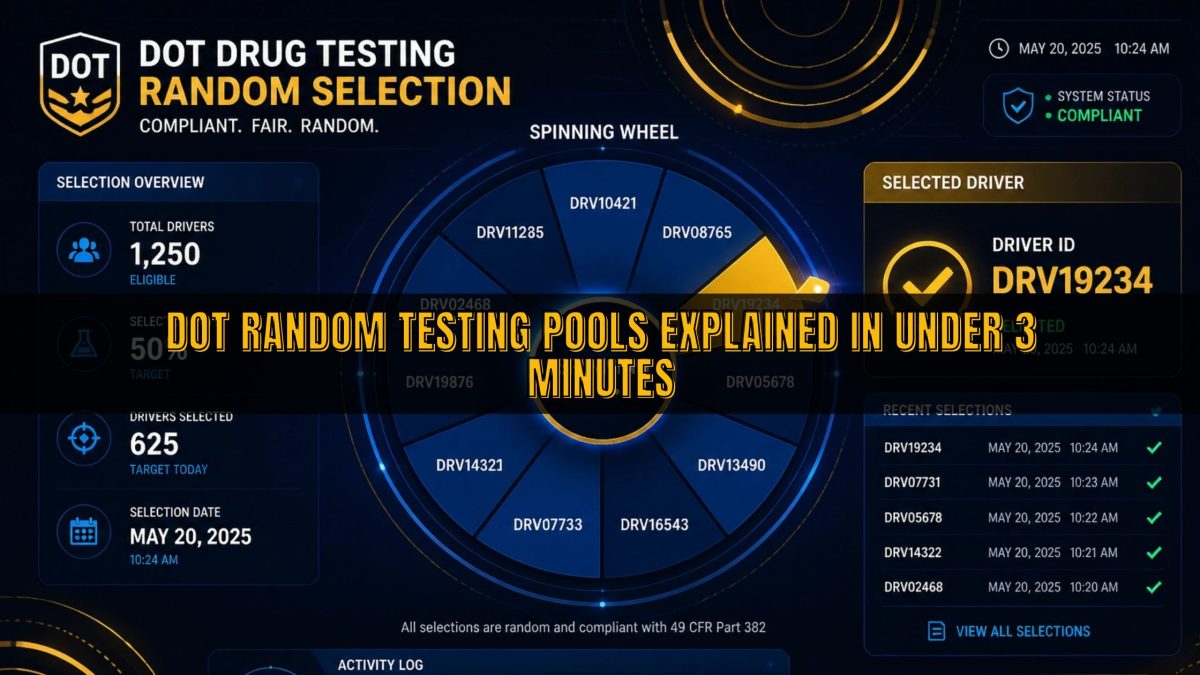
The selection process must be conducted using a scientifically valid method, which typically involves a computer-based random number generator. This software matches driver identification numbers with random digits to ensure that the human element is completely removed from the decision-making process. Because the selection is automated, it provides a layer of legal protection for employers, proving that no driver was singled out due to personal bias or performance issues.
Once the selection is made, the employer or the C/TPA receives a list of drivers who must be tested during the current cycle, which is usually quarterly or monthly. It is critical to understand that the timing of these tests must be spread reasonably throughout the year to maintain the element of surprise. You cannot simply test all your selected drivers on the first Monday of the year and call it finished; the FMCSA requires that the likelihood of being tested remains constant from January to December.
When a driver's name is pulled, the notification process must be handled with extreme care to prevent any attempts at subverting the test. The driver should only be notified when they are already on duty or immediately before they are about to go on duty. Once notified, the driver must proceed immediately to a collection site, as any delay could be considered a "refusal to test," which carries the same heavy penalties as a positive result.
QUICK TIP: Always ensure your driver list is updated with your C/TPA at the start of every month. If a driver leaves your company but stays in the pool, you might be paying for a slot you don't need, or worse, a selection could be "wasted" on someone who no longer works for you.
MANDATORY 2026 TESTING RATES AND REQUIREMENTS
For the 2026 calendar year, the FMCSA has maintained its rigorous testing requirements to ensure industry-wide safety. Carriers and consortia are required to conduct random drug tests at a rate of 50% of the average number of driver positions and random alcohol tests at a rate of 10%. These percentages are the minimum thresholds, and falling below them can result in significant fines and the potential loss of your operating authority during an audit.
The reason the drug testing rate remains at 50% is tied to the industry's overall positive test rate. If the industry-wide positive rate for controlled substances remains above 1% for any given year, the FMCSA keeps the requirement at 50% to discourage drug use among drivers. These statistics are gathered through the Management Information System (MIS) reports that carriers must file, highlighting the importance of every carrier doing their part to keep the industry clean.
It is a common misconception that if you only have two drivers, you only need to test one person per year to hit the 50% mark. In reality, the math is applied to the entire pool your drivers belong to, which is why being in a large consortium is so beneficial. In a large pool of 10,000 drivers, the consortium ensures that 5,000 drug tests and 1,000 alcohol tests are completed, satisfying the requirement for every individual member within that group.
ELIGIBILITY AND POOL MAINTENANCE

Not everyone at your company should be in the DOT random testing pool, and mismanaging your list can lead to compliance failures. Only employees who perform "safety-sensitive" functions, specifically those requiring a CDL, are eligible for the federal pool. If you accidentally include office staff or non-CDL mechanics in your DOT pool, you are technically in violation of the rules, as their privacy is being infringed upon by a federal mandate that does not apply to them.
Maintaining an accurate pool list is a continuous process that requires attention to detail every time you hire or terminate a driver. When a new driver joins your team, they must pass a pre-employment drug test and have a clean query in the FMCSA Clearinghouse before they can be added to the random pool. Once they are officially on the "active" list, they must remain there as long as they are expected to drive, even if they are temporarily out on medical leave or vacation.
The thing is, many carriers find the administrative side of pool maintenance to be the most frustrating part of the job. That is why Labworks USA provides an online account portal that allows you to manage your driver roster with just a few clicks. Keeping your roster current ensures that the random selections are always valid and that you are only paying for the drivers who are actually representing your fleet on the road.
WHY JOINING A CONSORTIUM IS THE SMARTEST MOVE
For owner-operators and small to mid-sized carriers, joining a consortium is not just a convenience: it is often a legal necessity. Small carriers with only a few drivers cannot mathematically meet the random testing requirements on their own because a "pool" of one or two people does not provide true randomness. By pooling your drivers with thousands of others, you gain the "strength in numbers" needed to satisfy FMCSA auditors and ensure your business remains compliant.
Beyond the legal requirements, a C/TPA like Labworks USA acts as a professional buffer between you and the complex regulations. We handle the random selection software, notify you when a driver is picked, and provide access to a network of over 20,000 collection sites nationwide. This means your drivers can get tested wherever they are on their route, reducing downtime and keeping your deliveries on schedule.
Cost-effectiveness is another major advantage of the consortium model. Instead of paying for expensive software and hiring a dedicated compliance officer, you pay a flat annual membership fee that covers the administration of the program. This allows you to focus your financial resources on equipment maintenance and fuel while we handle the heavy lifting of federal paperwork and reporting.
QUICK TIP: Look for a consortium that offers "all-in-one" support. Having your random pool, Clearinghouse management, and supervisor training under one roof prevents communication gaps and makes audits much smoother.
KEY STEPS AFTER A DRIVER IS SELECTED

When the notification arrives that one of your drivers has been selected for a random test, you must act decisively and quickly. The first step is to verify that the driver is currently on duty or about to start their shift. If the driver is on a long-term leave or has recently left the company, you must document this immediately and contact your C/TPA to determine if an alternate selection needs to be made from the pool.
Once the driver is notified, they must report to the collection site immediately. "Immediately" in the eyes of the DOT means that the driver should stop what they are doing (safely) and head to the clinic without stopping for a meal, a long break, or to finish a non-essential task. As an employer, it is your responsibility to ensure the driver has the correct electronic Chain of Custody Form (eCCF) or paper forms needed to complete the test successfully.
After the specimen is collected, it is sent to a SAMHSA-certified laboratory for analysis. The results are then reviewed by a Medical Review Officer (MRO), who is a licensed physician with specialized training in substance abuse. If the test is negative, the process is complete, and the results are uploaded to your secure portal for record-keeping. If the test is positive, you must immediately remove the driver from safety-sensitive duties and begin the Return-to-Duty process as required by law.
IN CONCLUSION: STAYING AHEAD OF THE CURVE
Understanding DOT random testing pools is a marathon, not a sprint, and staying updated on yearly changes is the only way to protect your business. The regulations are designed to evolve with the industry, and what worked five years ago might not be enough to pass a modern FMCSA audit. By staying vigilant and proactive, you turn a complex legal burden into a manageable part of your successful business operations.
Relying on a professional partner like Labworks USA ensures that you never have to worry about the "what-ifs" of drug and alcohol testing. We pride ourselves on being more than just a service provider; we are your dedicated compliance department. From the initial enrollment to the final MIS report at the end of the year, we are here to support your drivers and keep your trucks moving forward safely.
As we look toward the remainder of 2026 and beyond, the emphasis on road safety and driver health has never been higher. Taking the time to master the basics of random pools today will save you from the stress and financial strain of non-compliance tomorrow. Stay safe, stay informed, and remember that we are always just a phone call away to help you navigate the road to total compliance.
JOIN THE LABWORKS USA CONSORTIUM TODAY
Don't let the stress of federal regulations slow down your fleet. Labworks USA offers a comprehensive DOT Drug and Alcohol Testing Consortium membership for just $199 per year. This annual membership ensures you are fully compliant with FMCSA random testing requirements and gives you the peace of mind to focus on the road.
Our Core Services Include:
- Full enrollment in our DOT-compliant random testing pool.
- Access to over 20,000 collection sites across the United States.
- Expert Medical Review Officer (MRO) services for all tests.
- Complete FMCSA Clearinghouse management and support.
- Electronic Chain of Custody Forms (eCCF) for faster results.
Ready to simplify your compliance? Sign up now or check out our competitive rates to see how much you can save by partnering with the experts.