 Jun 9, 2026
FMCSA Random Testing Rates Explained in Under 3 Minutes
Navigating the world of DOT compliance can often feel like trying to drive a semi-truck through a needle’s eye during a blizzard. Between the changing federal mandates and the constant pressure of delivery deadlines, staying on top of your regulatory obligations is a full-time job in itself. The Federal Motor Carrier Safety Administration (FMCSA) sets specific annual random testing rates that every carrier and owner-operator must strictly adhere to if they want to keep their authority active.
The thing is, these rates aren't just arbitrary numbers plucked out of thin air by a government bureaucrat. They are carefully calculated based on industry-wide violation data gathered from the previous calendar year to ensure the safety of everyone on the American highways. By understanding exactly what is expected of you, you can transition from a state of compliance anxiety to a position of operational confidence.
At Labworks USA, we believe that compliance shouldn't be a hurdle that slows your business down, but rather a foundation that keeps your wheels turning safely. This guide is designed to break down the current 2026 random testing requirements into plain English so you can get back to what you do best: driving. We handle the administrative heavy lifting so that you don't have to worry about a surprise audit or a sudden downgrade of your safety rating.
WHAT ARE THE FMCSA RANDOM TESTING RATES FOR 2026?
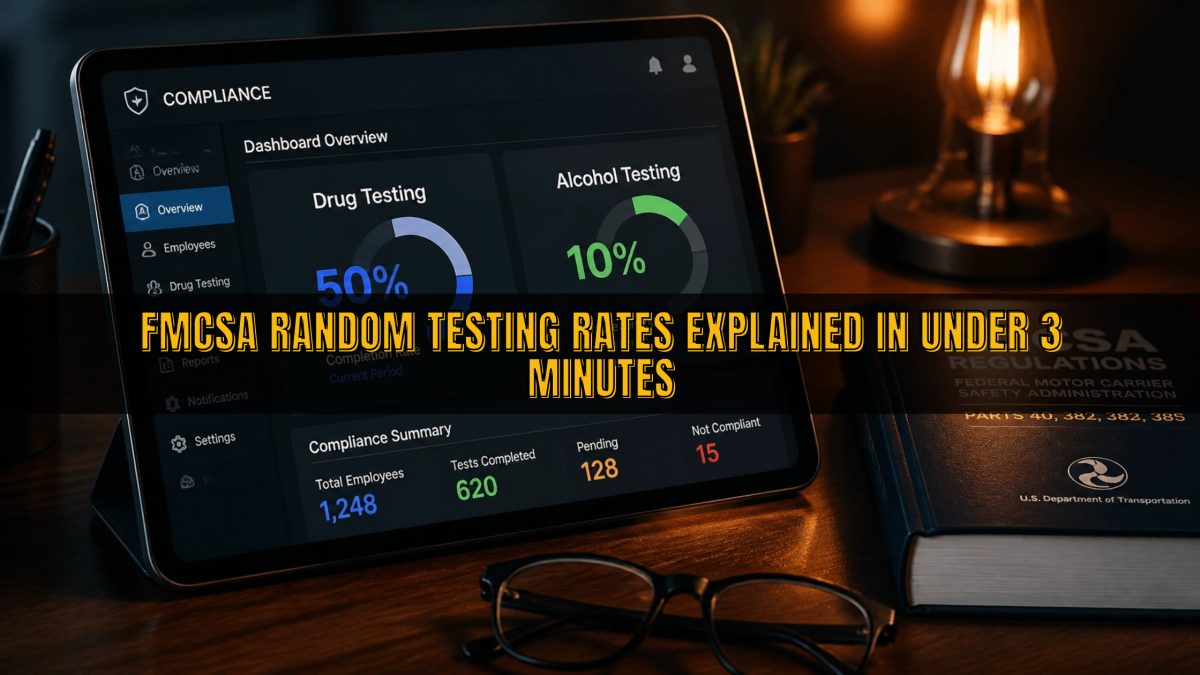
For the 2026 calendar year, the FMCSA has officially announced that the minimum annual random testing rates will remain consistent with the previous year’s requirements. This means that motor carriers must continue to conduct random drug tests at a rate of 50 percent of the average number of driver positions. Additionally, the random alcohol testing rate remains set at a minimum of 10 percent for the same period.
Maintaining these specific percentages is a non-negotiable requirement for all CDL drivers operating on public roads, including those in the private and public sectors. Whether you are a large fleet manager or an independent owner-operator, these numbers dictate the minimum volume of selections you must process throughout the year. Failing to meet these quotas can result in significant fines and increased scrutiny from federal investigators during a roadside inspection or a facility audit.
It is important to remember that these percentages represent the minimum annual requirements, not a maximum limit. Some carriers choose to test at a slightly higher rate to ensure they never fall below the threshold due to driver turnover or fluctuations in their workforce size. Partnering with a professional consortium like Labworks USA ensures that your annual membership keeps you exactly where you need to be regarding these federal benchmarks.
WHY THE RATES STAY AT 50% AND 10%
The FMCSA determines these rates by looking at the "positive rate" of tests across the entire industry during the prior year. According to official DOT ODAPC guidelines, the drug testing rate remains at 50 percent if the industry-wide positive rate is equal to or greater than 1.0 percent. Conversely, the alcohol testing rate only drops if the industry-wide violation rate stays below 0.5 percent for two consecutive years.
Because the data from recent years has shown a consistent need for vigilance, the 50 percent drug testing requirement has become the standard for the foreseeable future. This high rate is intended to serve as a powerful deterrent against controlled substance use among professional drivers who operate heavy machinery. It also ensures that a significant portion of the driving population is screened annually, which helps in identifying individuals who may need assistance through a Return to Duty program.
The stability of these rates for 2026 allows carriers to plan their compliance budgets and schedules with a high degree of predictability. You don't have to guess whether the rules will change mid-year, which makes managing your FMCSA Clearinghouse responsibilities much more straightforward. Understanding the "why" behind the numbers helps reinforce the importance of these safety protocols as a shared industry responsibility.

UNDERSTANDING THE RANDOM SELECTION PROCESS
The core of a successful program is the "randomness" of the selection, which must be performed using a scientifically valid method, such as a computer-based random number generator. Every driver in the pool must have an equal chance of being selected during every single drawing period, regardless of how many times they have been tested in the past. This means a driver could theoretically be selected two months in a row, or not at all for an entire year, provided the math remains truly random.
Selection periods are typically spread throughout the year: often quarterly or monthly: to ensure that the testing is not predictable for the drivers. Once a driver is notified of their selection, they must proceed immediately to a collection site to provide a specimen. Any delay in reporting to the site can be considered a "refusal to test," which carries the same heavy penalties as a positive test result under FMCSA regulations.
Managing this process internally can be an administrative nightmare for small businesses and owner-operators who are busy hauling freight. That is why the vast majority of independent drivers choose to join a random testing pool managed by a Third-Party Administrator. This approach ensures that the selection logic is handled by an unbiased system, protecting the carrier from accusations of unfair targeting or discrimination.
HOW CONSORTIUMS MAKE LIFE EASIER FOR OWNER-OPERATORS
If you are an owner-operator, the FMCSA actually requires you to belong to a Consortium/Third-Party Administrator (C/TPA) for your random testing needs. You cannot legally manage your own random pool because you cannot "randomly" select yourself without a conflict of interest. Joining a consortium like Labworks USA places you into a larger pool of drivers from various companies, ensuring that the selection process remains entirely hands-off and compliant.
Beyond just the selection process, a C/TPA provides a comprehensive safety net for your entire compliance program. We provide access to an extensive network of over 20,000 collection sites nationwide, so you are never far from a laboratory no matter where your route takes you. Our members also benefit from electronic Chain of Custody Forms (eCCF), which eliminate the hassle of lost paperwork and speed up the reporting process.
The convenience and practical value of a consortium cannot be overstated when you consider the alternative of managing laboratories, MROs, and federal reporting yourself. By outsourcing these tasks, you ensure that every box is checked and every deadline is met without having to spend your weekends buried in regulatory fine print. It is the most efficient way to maintain your "good standing" with the DOT while focusing on growing your business.

THE CONSEQUENCES OF MISSING THE MARK
The legal and financial consequences of failing to meet the 50 percent drug or 10 percent alcohol testing rates are severe. During a New Entrant Audit or a routine compliance review, the FMCSA will verify your "Summary of Training and Testing" to see if you reached the required quotas. If you fall short, you could face civil penalties that range into the thousands of dollars per violation, often far exceeding the cost of a multi-year membership.
Perhaps even more damaging than the fines is the impact a compliance failure can have on your Safety Measurement System (SMS) scores. High scores in the "Controlled Substances/Alcohol" category act as a red flag to insurance companies, which can lead to skyrocketing premiums or the total cancellation of your policy. In an industry with razor-thin margins, these additional costs can easily put a small carrier out of business.
Finally, there is the risk of a CDL downgrade or a "Prohibited" status in the FMCSA Clearinghouse for drivers who fail to comply with testing orders. Once a driver is marked as prohibited, they cannot legally operate a commercial motor vehicle until they complete the intensive Substance Abuse Professional (SAP) process. Staying ahead of the random testing rates is the only way to protect your livelihood and the safety of the motoring public.
STEPS TO STAY COMPLIANT YEAR-ROUND
Maintaining compliance is a year-round commitment that starts with keeping an accurate and updated list of your active drivers. You must ensure that every new hire has a negative pre-employment drug test on file before they ever get behind the wheel. Regularly auditing your driver roster ensures that the random selection pool is based on the correct "average number of driver positions," as required by the FMCSA.
Another vital step is ensuring that your Designated Employer Representative (DER) and supervisors are properly trained. Under DOT rules, supervisors must receive at least 60 minutes of training on alcohol misuse and 60 minutes on controlled substance use. At Labworks USA, we provide DOT Approved Supervisor Training for free to members with five or more drivers, helping you recognize the signs of impairment before an accident happens.
Finally, you should make it a habit to log into your portal and review your testing statistics at least once a quarter. This allows you to catch any potential issues early and ensures that your testing frequency is on track to meet the annual 50 percent and 10 percent targets. Proactive management is always cheaper and less stressful than reactive scrambling when an auditor knocks on your door.
IN CONCLUSION
The 2026 FMCSA random testing rates of 50 percent for drugs and 10 percent for alcohol are essential benchmarks for a safe and professional trucking industry. While these requirements may seem daunting at first glance, they are manageable when broken down into clear, actionable steps. Consistency is the key to passing any audit and ensuring that your fleet remains on the road without unnecessary interruptions.
The thing is, you don't have to navigate these complex federal regulations on your own. The landscape of DOT compliance is constantly shifting, with new rules regarding oral fluid testing and Clearinghouse reporting being introduced regularly. Staying informed is half the battle, but having a dedicated team of experts in your corner is what truly ensures long-term success and peace of mind.
That’s why Labworks USA is committed to being more than just a service provider; we are your partner in safety. We handle the paperwork, the random selections, and the regulatory updates so that you can focus on the road ahead. Whether you are an owner-operator or a fleet manager, our goal is to make compliance the easiest part of your business day.
JOIN THE LABWORKS USA CONSORTIUM TODAY
Stay ahead of the 2026 requirements with the most trusted name in DOT compliance. Our comprehensive membership packages are designed to fit your specific needs and budget.
- DOT Drug & Alcohol Testing Consortium Membership: Starting at just $199/year for Owner-Operators.
- Complete Clearinghouse Management: Starting at $50/year.
- Bulk Fleet Pricing: Custom quotes available for larger carriers.
Get Started Now - Sign Up Online or Contact Our Team to discuss your compliance needs.