 Jan 13, 2026
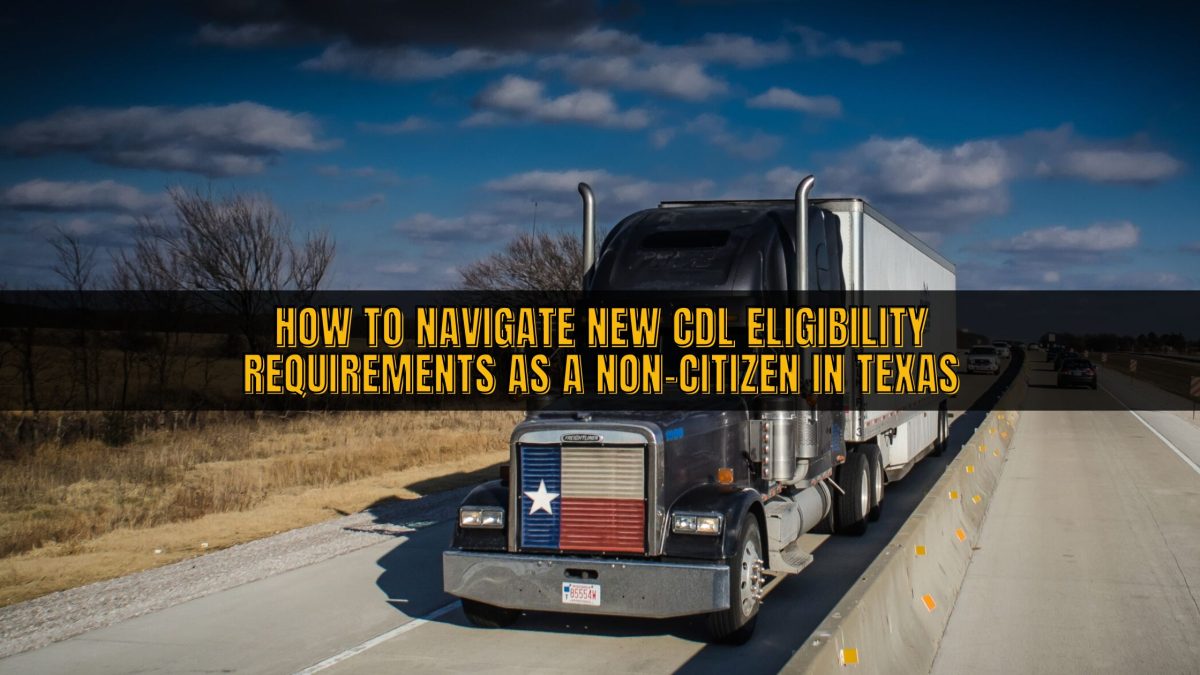
How To Navigate New CDL Eligibility Requirements As A Non-Citizen In Texas
Navigating the complexities of obtaining a Commercial Driver's License (CDL) can be particularly challenging for non-citizens in Texas, especially with the recent updates to eligibility requirements. As the demand for skilled drivers continues to rise, understanding the specific criteria and processes applicable to non-citizens is paramount for those looking to pursue a career in the transportation industry.
Texas, with its vast economy and reliance on freight movement, offers numerous opportunities for individuals willing to navigate the regulatory landscape. This article aims to provide a comprehensive overview of the new CDL eligibility requirements, detailing the necessary documentation, legal considerations, and procedural steps that non-citizens must follow to secure their licenses.
By demystifying these requirements, we hope to empower aspiring drivers to successfully embark on their journey, ensuring they are well-informed and prepared to meet both state and federal regulations. Whether you are a permanent resident, visa holder, or other non-citizen looking to enter this vital workforce, understanding these guidelines is crucial for your success.
Join us as we explore the essential steps and resources needed to effectively navigate the path to obtaining a CDL in Texas, tailored specifically for non-citizen applicants.
Texas Suspends Non-Domiciled CDLs: A Complete Guide to the 2025 Federal Mandate and Industry Fallout
On September 30, 2025, the Texas Department of Public Safety (DPS) formally declared the immediate suspension of commercial driver license (CDL) issuance to non-citizens, a landmark decision precipitated by a new federal directive aimed at drastically strengthening regulations surrounding commercial licensing in the United States. This move, which has sent shockwaves through the logistics and transportation sectors, marks one of the most significant tightenings of entry requirements for the trucking workforce in decades.
Effective immediately, the state of Texas has ceased the issuance, renewal, or reissuance of CDLs for individuals classified as refugees, asylees, or recipients of Deferred Action for Childhood Arrivals (DACA). Additionally, all pending applications and testing processes for these groups have been placed on indefinite hold.
This decision is not an isolated state-level policy but the first domino to fall in a broader federal strategy orchestrated by the Trump Administration and U.S. Transportation Secretary Sean Duffy. The directive serves as a response to growing concerns regarding national security, roadway safety, and the economic stability of the domestic freight market.
By strictly limiting CDL eligibility to U.S. citizens, lawful permanent residents, and a narrow band of specific visa holders, authorities aim to curb what they describe as "CDL mills" and systemic fraud in the licensing process. The immediate consequence has been confusion at DMV counters across Texas and a frantic reassessment of labor capacity by carriers who have long relied on a diverse driver pool to keep wheels turning.
For industry stakeholders, from independent owner-operators to mega-carrier safety directors, understanding the nuance of this suspension is critical. The changes go beyond simple eligibility; they signal a fundamental shift in how the Federal Motor Carrier Safety Administration (FMCSA) views the privilege of operating a commercial motor vehicle (CMV).
With federal audits revealing extensive violations in multiple states and funding threats looming for non-compliant jurisdictions, the Texas suspension is the harbinger of a new national standard—one that prioritizes strict legal status and English proficiency over labor supply availability.
The Scope of the Suspension: Who is Affected?
The Texas DPS directive is precise in its exclusions, targeting specific categories of non-citizens who previously had access to non-domiciled CDLs. A non-domiciled CDL is defined as a commercial driver’s license granted to individuals who are not permanent residents of Texas or the United States but possess legal work status.
Historically, this allowed a wide range of individuals with valid Employment Authorization Documents (EADs) to enter the trucking workforce. However, the new enforcement paradigm strictly narrows this eligibility.
The suspension explicitly bars refugees, asylum seekers, and DACA recipients—groups that comprise a significant portion of the non-domiciled driver population—from obtaining or renewing their commercial licenses. Under the new Interim Final Rule (IFR) titled "Restoring Integrity to the Issuance of Non-Domiciled Commercial Driver’s Licenses," eligibility is now largely restricted to holders of specific employment-based visas, primarily H-2A (temporary agricultural workers), H-2B (temporary non-agricultural workers), and E-2 (treaty investors).
This shift effectively invalidates the commercial driving privileges of tens of thousands of drivers whose legal presence in the U.S. does not fall into these strictly defined categories. For drivers currently on the road with a CDL linked to a now-ineligible status, the clock is ticking; renewals will be denied, and downgrades to non-commercial licenses are imminent upon the expiration of current documents.
The operational impact on Texas is profound. According to data reported by Overdrive, Texas has recorded the highest issuance of non-domiciled CDLs among participating states since 2015.
Over that period, the state has issued over 3.2 million CDLs in total, with 51,993 specifically designated for non-domiciled drivers. In 2024 alone, Texas issued 6,265 CDLs to non-citizen applicants, a number that reflects the heavy reliance on this labor pool in a border state with massive freight volumes.
By freezing this pipeline, Texas is effectively removing thousands of drivers from the pool, a move that industry analysts predict will have immediate effects on capacity for regional and long-haul lanes originating in the Lone Star State.
The 'America First' Safety Initiative and Federal Oversight
The catalyst for this sweeping change is the aggressive stance taken by the Department of Transportation (DOT) under the leadership of Secretary Sean Duffy. The administration has framed these regulations not merely as bureaucratic adjustments but as essential national security and public safety measures.
This "America First" approach to trucking regulation argues that the previous system was too porous, allowing individuals with unverified driving histories and inadequate language skills to operate 80,000-pound vehicles on American highways. The administration’s rhetoric focuses heavily on "restoring law and order" to the supply chain, positing that economic protection for domestic drivers must be balanced with rigorous safety standards. John Esparza, President and CEO of the Texas Trucking Association, voiced strong support for these enhanced enforcement measures, aligning the association with the federal crackdown.
"The Texas Trucking Association has consistently championed highway safety in Texas, collaborating with both state and federal regulators to eliminate unsafe operators from our roads," Esparza commented. "We back the Trump Administration and U.S. Transportation Secretary Duffy in their efforts to combat fraud and remove unqualified drivers from our highways.
This issue not only jeopardizes public safety but also poses a threat to our nation’s trade and economic stability." His statement reflects a significant segment of the industry that views the tightening of rules as a necessary correction to years of lax oversight.
This decision in Texas follows an emergency rule issued by the FMCSA in direct reaction to a series of tragic accidents involving immigrant truck drivers, many of whom were later revealed to be operating with invalid licenses or without the ability to read critical road signage. These incidents have become flashpoints in the national debate, providing the political capital necessary for the DOT to implement such restrictive measures without the typical lengthy notice-and-comment periods.
The FMCSA’s stance is that the "imminent hazard" posed by unqualified drivers necessitates immediate action, overriding complaints about driver shortages or supply chain disruptions.
English Proficiency: The New "Two-Step" Enforcement
In a related and equally impactful note, federal authorities have mandated that states enforce English-language proficiency (ELP) requirements with unprecedented rigor. This aligns perfectly with Texas's decision to halt CDLs for non-citizens and serves as a secondary filter to remove unqualified drivers from the road.
While the requirement for drivers to speak and read English (49 CFR § 391.11(b)(2)) has been on the books for decades, enforcement has historically been lenient or nonexistent. That has changed.
The new directive instructs law enforcement and roadside inspectors to utilize a strict "two-step" assessment process during all interactions with commercial drivers. The first step involves a conversational interview where the officer asks the driver about their cargo, route, and hours of service.
If the driver cannot respond sufficiently in English, or relies on translation apps (which are now explicitly prohibited during inspections), the officer proceeds to step two: a signage recognition test. Drivers must be able to read and explain common highway signs and safety warnings in English.
Failure at this stage results in the driver being placed immediately Out of Service (OOS). This is a career-ending citation for many, as it flags the driver in the Drug and Alcohol Clearinghouse and safety databases as unqualified to drive.
On August 26, the U.S. Department of Transportation (DOT) announced that it may withhold millions in federal highway funding from states that fail to enforce these standards. Specifically, the DOT has threatened California, New Mexico, and Washington—states with "sanctuary" policies that have historically been more lenient regarding CDL issuance to undocumented or non-English speaking individuals. DOT officials have given these three states a strict 30-day window to comply with federal regulations or face potential funding losses from the Motor Carrier Safety Assistance Program.
California could face a loss of $33 million, Washington $10.5 million, and New Mexico $7 million. This financial leverage ensures that the crackdown will not be limited to Texas; it effectively forces blue states to adopt the same restrictive policies or risk their infrastructure budgets.
The Audits: Uncovering Systemic Fraud and "CDL Mills"
The justification for these drastic measures is rooted in the results of comprehensive federal audits conducted throughout 2024 and 2025. These investigations revealed extensive violations across several states, including Texas, California, Colorado, Pennsylvania, South Dakota, and Washington, where CDLs had been issued to individuals lacking valid immigration status or falsified residency documents.
The audits uncovered a network of "CDL mills"—training schools and third-party testers that rubber-stamped applicants in exchange for cash, bypassing mandatory skills tests and English proficiency checks. In many cases, investigators found that "chameleon carriers"—unsafe trucking companies that shut down and reopen under new names to avoid penalties—were actively recruiting these non-domiciled drivers because they could be paid below-market wages and were less likely to report safety violations.
The FMCSA’s data suggests that drivers from these programs have a statistically higher crash risk due to a lack of genuine training. By suspending non-domiciled CDLs for the most vulnerable groups (refugees/asylees), the agency argues it is cutting off the supply of exploitable labor that fuels these fraudulent operations.
However, critics argue that the broad brush of the suspension unfairly penalizes legitimate, safe drivers who have been working in the industry for years. They point out that many refugees and DACA recipients have clean driving records and have been essential to the logistics workforce.
The audit's focus on "immigration status" rather than "driving history" as the primary disqualifier has led to accusations of discrimination. Yet, the DOT maintains that legal presence and the ability to read English are foundational, non-negotiable safety standards that cannot be waived for the sake of economic convenience.
Economic Fallout: Rates, Capacity, and Supply Chain Impact
The economic implications of removing an estimated 194,000 drivers (nationwide projection based on the IFR) from the workforce are staggering. The "driver shortage," a perennial talking point in the industry, is set to exacerbate significantly in the short term. As Texas and other states begin to downgrade and revoke licenses, carriers are scrambling to fill seats.
This sudden contraction in labor supply is expected to drive up spot market rates, particularly in the border regions where cross-border trade with Mexico relies heavily on bilingual or non-domiciled drivers. For logistics managers, this means volatility.
The "cheap capacity" provided by carriers utilizing non-domiciled labor is evaporating, forcing shippers to renegotiate contracts with carriers that employ fully compliant, domestic drivers—who command higher wages. Industry analysts predict a spike in freight rates in Q4 2025 and throughout 2026 as the market adjusts to the new labor reality. Small fleet owners who built their business models around immigrant labor face existential threats, with insurance providers already beginning to drop coverage for fleets with high percentages of non-domiciled drivers.
Conversely, many American owner-operators and company drivers view this contraction as a long-overdue market correction. On social media platforms and industry forums, there is a palpable sense of relief among domestic drivers who have seen freight rates plummet in recent years.
The prevailing sentiment in these circles is that the removal of "cheap labor" will force shippers to pay fair rates again, potentially revitalizing the earnings of American truckers. This economic tug-of-war—between shippers wanting low costs and drivers wanting fair pay—is now playing out against the backdrop of federal enforcement.
Industry Sentiment: The "Reddit" Perspective
To truly understand the impact of this ruling, one must look at the unfiltered conversations happening on platforms like Reddit (r/Truckers), The Truckers Report, and various Facebook groups. The digital water coolers of the trucking industry are ablaze with debate.
The terminology used here is raw and revealing. Drivers frequently refer to the targeted group as "steering wheel holders"—a derogatory term for drivers who lack skill and training—and blame them for driving down freight rates to unsustainable levels ("cheap freight").
Threads discussing the Texas suspension are filled with comments celebrating the move. "Finally, maybe rates will go back up to $2/mile," one user posted, reflecting the deep economic anxiety of the American driver.
Others share anecdotal horror stories of "flip-flop brigades" (a slur targeting drivers who wear unprofessional footwear) causing accidents or clogging fuel islands. There is a strong "us vs. them" narrative, where domestic drivers feel they have been displaced by drivers willing to work for pennies and disregard safety laws.
However, there is also a counter-narrative. Some drivers and fleet owners worry about the "slippery slope" of government overreach. "Today it's them, tomorrow it's us," warns a dissenting voice, suggesting that giving the FMCSA more power to revoke licenses arbitrarily is dangerous.
Furthermore, specialized haulers who rely on H-2B visa holders for seasonal work are confused about the nuances of the rule, fearing they will lose their experienced crews. The complexity of the regulation—distinguishing between a refugee (ineligible) and an H-2B holder (eligible)—is causing widespread confusion on the ground, with many fearing that overzealous roadside inspectors will simply OOS anyone with a foreign accent.
Conclusion: A New Era for American Trucking
The September 30, 2025, decision by the Texas DPS is more than a bureaucratic rule change; it is a defining moment for the U.S. trucking industry. By aligning state policy with a strict federal "America First" safety agenda, Texas has set a precedent that will likely be followed by other red states and forced upon blue states through financial coercion.
The suspension of CDLs for refugees, asylees, and DACA recipients marks the end of an era of open access to the trucking profession for new immigrants. As the industry moves forward, the focus will shift to compliance and adaptation. Carriers must audit their own fleets to ensure every driver meets the new strict criteria, or risk devastating fines and shutdowns.
Shippers must prepare for higher costs and tighter capacity. And for the drivers remaining on the road, the hope is that this "restoring of integrity" will indeed lead to safer highways and better pay—though the cost of this transition, in human and economic terms, remains to be fully counted. The road ahead is clearer, but it is also much narrower.
Navigate the Compliance Crackdown with Confidence
The recent legislative shifts in Texas and the federal crackdown on CDL eligibility prove one thing: the era of lenient oversight is over. As regulations tighten around driver status and safety standards, your fleet cannot afford additional scrutiny from the DOT or FMCSA. To navigate these rapid industry changes and protect your business from the growing wave of audits, stay connected with us for the latest actionable insights and logistics trends.
Furthermore, ensure your compliance foundation is rock solid with Labworks USA. In an environment where every driver file is potentially subject to review, you need a partner who understands the stakes. Our DOT Consortium is dedicated to ensuring you remain fully compliant with random DOT drug and alcohol testing requirements.
Whether you need assistance with FMCSA Clearinghouse registration or general compliance questions, our team is ready to support you, ensuring your drivers remain road-legal and your business remains audit-proof.