 Oct 1, 2026
Urine vs Oral Fluid vs Hair: Which DOT Testing Method Will Actually Protect Your Fleet in 2026?
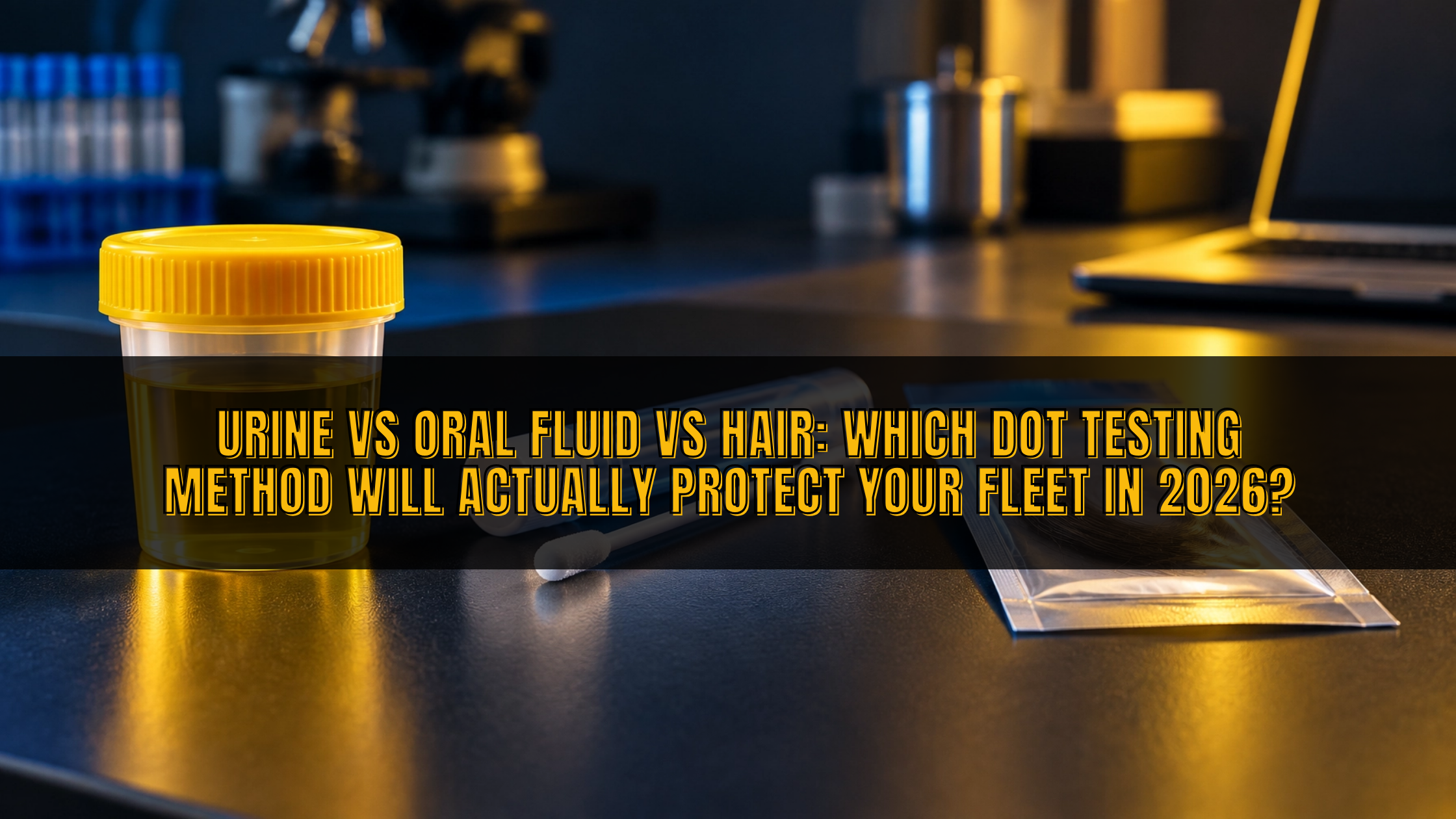
For a DOT-regulated carrier, choosing a specimen type is not simply a question of which test is newest or most convenient. Your testing method must be authorized under federal rules, supported by proper laboratory procedures, and matched to the purpose of the test, whether you are hiring a driver, conducting a random selection, or responding to a qualifying accident. In 2026, urine remains the practical DOT workhorse, oral fluid is authorized in the regulations but still subject to implementation requirements, and hair testing remains outside the DOT program.
That distinction matters because using the wrong specimen can create a compliance problem instead of solving one. The DOT’s current Part 40 guidance authorizes urine and oral fluid specimens tested by HHS-certified laboratories, while specifically excluding hair, instant tests, and point-of-collection tests from DOT testing. Here is what you need to know before changing your fleet’s policy.
THE 2026 RULE IN PLAIN LANGUAGE
The Department of Transportation’s June 10, 2026, final rule addressed a practical problem with oral fluid testing. Oral fluid was added to DOT regulations as an alternative specimen type, but implementation depends on the availability of at least two HHS-certified oral fluid laboratories, a qualified collector, and an approved collection device at the collection site. Until those conditions are satisfied, oral fluid cannot simply be ordered as a routine replacement for urine.
The rule also explains what happens when a directly observed collection is required but oral fluid is not available. In that situation, the employer must arrange a directly observed urine collection in accordance with Part 40 procedures. You can review the rule in the Federal Register publication for the June 2026 amendment.
For now, your DOT drug testing program should be built around laboratory-based urine testing unless your consortium or C/TPA confirms that an eligible oral fluid program is genuinely available for the specific collection event. Hair testing may be useful in a separate non-DOT company policy, but it cannot replace a required DOT test.
Quick Tip: Do not change your company policy based on a headline announcing that oral fluid is “approved.” Ask whether the required HHS-certified laboratories, trained collector, and compliant collection devices are actually available. A qualified C/TPA can monitor that transition and help you update your procedures when the operational requirements change.
URINE VS. ORAL FLUID VS. HAIR: SIDE-BY-SIDE
The following comparison gives you the practical difference between the three specimen types. Detection windows are estimates, not guarantees, because results vary by substance, dosage, frequency of use, metabolism, specimen quality, and laboratory cutoff levels. The legal status column is the most important one for DOT compliance.
| Factor | Urine | Oral fluid | Hair |
|---|---|---|---|
| DOT status in 2026 | Fully implemented and widely available | Authorized in Part 40, but conditional on operational availability | Not authorized for DOT testing |
| Typical detection focus | Recent-to-recent-plus use, often several days or longer for cannabis | More recent use, often hours to roughly one or two days depending on the drug | Longer-term pattern, commonly several weeks to approximately 90 days in non-DOT programs |
| Collection process | Private restroom collection with specimen validity checks | Collector observes the collection from the employee’s oral cavity | Hair is cut close to the scalp, usually from the head |
| Direct observation | Required in specific Part 40 circumstances | The collection is inherently directly observed | Not an authorized DOT collection |
| Adulteration concern | Requires temperature, validity, and chain-of-custody controls | More difficult to adulterate after collection begins, but collection conditions still matter | External contamination, hair characteristics, and laboratory methodology require careful controls |
| Cost and availability | Broad nationwide network and established pricing | Availability and pricing may vary while the infrastructure develops | May be available for non-DOT programs, but cannot satisfy DOT requirements |
| Best current DOT use | Pre-employment, random, post-accident, reasonable suspicion, return-to-duty, and follow-up | Future alternative when all regulatory conditions are met | Non-DOT supplemental policy only |
The best testing method is therefore not automatically the one with the longest detection window. You need a method that is legally permitted, available when the driver needs testing, processed by an authorized laboratory, and documented correctly from collection through MRO review.
URINE: THE ESTABLISHED DOT WORKHORSE
Urine remains the most practical choice for a DOT pre-employment drug test because the process is established across the country. A driver provides a specimen at a qualified collection site, the collector checks the specimen for required conditions, and the sample is sent through the laboratory and Medical Review Officer process. Urine testing is also widely supported for random, post-accident, reasonable-suspicion, return-to-duty, and follow-up testing.
The urine detection window is generally longer than oral fluid, although no test can determine impairment or identify an exact time of use. Many substances may be detectable for several days, while cannabis may remain detectable longer depending on the driver’s use pattern and individual physiology. This broader window is one reason urine remains a dependable fit for a comprehensive DOT program.
Urine also has the strongest operational advantage in 2026. Collection sites, collectors, laboratory workflows, electronic Chain of Custody Forms, MRO review, and reporting processes are already familiar to carriers and service agents. Labworks USA lists common services such as pre-employment testing at $83, random drug testing at $82, and post-accident testing at $107, although onsite and emergency collection charges may vary.
ORAL FLUID TESTING EXPLAINED
Oral fluid testing uses a collection device placed in the employee’s mouth while the collector observes the process. Because the sample is collected directly in front of the collector, oral fluid is considered directly observed for Part 40 purposes. The process can reduce privacy concerns associated with urine collection and may make it more difficult for an employee to substitute or dilute a specimen before collection.
Its shorter detection window is both its main advantage and its main limitation. Oral fluid is better suited to identifying more recent exposure, which can make it attractive for post-accident or reasonable-suspicion situations when the timing of a suspected event matters. However, a shorter window can also miss earlier use that a urine test might detect, so you should not treat oral fluid as universally “better” than urine.
The key issue is availability, not merely authorization. The June 2026 rule requires at least two HHS-certified oral fluid laboratories, along with a qualified collector and conforming collection device, before an employer can use oral fluid testing. Until your C/TPA verifies those conditions, continue following your established urine procedures and do not purchase an instant saliva test as a DOT substitute.
Quick Tip: A rapid or instant oral fluid test marketed for workplace use is not automatically a DOT test. Under Part 40, DOT specimens must be screened and confirmed through the required HHS-certified laboratory process. Ask your testing administrator to confirm whether a proposed oral fluid workflow is DOT-compliant before using it.
HAIR TESTING: WHAT TO WATCH, NOT WHAT TO USE FOR DOT
Hair testing can provide a longer lookback period than urine or oral fluid, which is why some carriers use it as a supplemental non-DOT hiring tool. A typical head-hair sample may reflect a period of several weeks to approximately 90 days, depending on the amount collected, hair growth, and the laboratory’s validated process. That longer window can help identify patterns of use, but it is not designed to answer whether a driver recently used a substance or was impaired at a particular time.
Hair is not currently authorized as a DOT specimen under 49 CFR Part 40. The rule specifically limits DOT testing to urine and oral fluid specimens processed by HHS-certified laboratories, so a positive hair result cannot replace the required DOT test or independently satisfy your FMCSA testing obligations. If you use hair testing, keep it clearly separated from your DOT program, policy language, consent process, and employment decision procedures.
Congressional and regulatory activity could change the future status of hair testing. The FMCSA statutory rulemaking report identifies hair testing as dependent on final HHS guidelines and subsequent DOT rulemaking, while proposed legislation has addressed reporting certain hair-test results to the Clearinghouse. Until those steps are complete, treat hair as a watch-list development rather than a DOT compliance solution.

WHICH METHOD FITS EACH TESTING SITUATION?
For a DOT pre-employment drug test, urine is the safest operational choice today because it is available through established collection networks and fully integrated into DOT procedures. Before placing a driver in a safety-sensitive position, you must also complete the required FMCSA Clearinghouse pre-employment query and obtain the necessary consent. Labworks USA can help carriers manage the testing and Clearinghouse responsibilities together rather than treating them as separate tasks.
For random testing, urine continues to make the most sense for most fleets because it supports rapid scheduling across a broad geographic area. Your random pool must be maintained accurately, selections must be genuinely random, and selected drivers must complete testing within the required timeframe. A reliable consortium administrator can manage selections, maintain driver status, and help document completion.
For post-accident, reasonable-suspicion, return-to-duty, and follow-up situations, timing and procedure are critical. Oral fluid may eventually offer a practical way to capture more recent use, but it is not a license to delay testing while searching for a new collection method. Today, you should use the established DOT process, arrange emergency or onsite collection when appropriate, and ensure that any directly observed collection follows Part 40 requirements.
WHAT YOU SHOULD DO TODAY
Your 2026 compliance checklist should focus on implementation rather than speculation. Review your policy, confirm your collection network, and make sure every driver and supervisor understands what happens after a triggering event. The convenient and practical approach is to have one qualified administrator coordinate testing, records, MRO communication, Clearinghouse reporting, and follow-up requirements.
Use this checklist to keep your program ready:
- Continue using laboratory-based urine testing for DOT-required events unless your C/TPA confirms compliant oral fluid availability.
- Do not use hair testing as a substitute for a DOT test.
- Confirm that pre-employment testing and the required Clearinghouse query are completed before placing a driver in service.
- Maintain accurate active and inactive driver records for random selections.
- Keep written procedures for post-accident and reasonable-suspicion testing.
- Train supervisors on the signs and documentation requirements for reasonable-suspicion determinations.
- Verify that collection sites can support emergency, onsite, and directly observed collections when needed.
- Monitor DOT, FMCSA, HHS, and Federal Register updates before changing your specimen policy.

RELATED SEARCH TERMS AND OFFICIAL RESOURCES
If you are researching this topic further, these are useful terms to discuss with your DER or C/TPA:
- DOT pre employment drug test
- FMCSA drug testing regulations
- Oral Fluid Testing Explained
- DOT drug testing panel
- DOT random drug testing consortium
- directly observed urine collection
- DOT post-accident drug test
- FMCSA Clearinghouse pre-employment query
- HHS-certified oral fluid laboratory
- non-DOT hair testing policy
For the official framework, review the DOT Part 40 overview, the specimen authorization rule at §40.210, and the June 2026 Federal Register rule. For Labworks USA account support, you can also review the company’s Clearinghouse management services and compliance checklist.
IN CONCLUSION
Urine is still the specimen type that will protect most fleets best in 2026 because it is authorized, available, familiar, and supported by a mature DOT testing system. Oral fluid is an important development with a shorter detection window and an inherently observed collection, but its practical use depends on regulatory and laboratory availability. Hair testing may become more relevant if HHS and DOT complete the necessary rulemaking, but it is not a replacement for DOT testing today.
The thing is, compliance is not a one-time purchase or a single test result. You must keep policies, driver records, random selections, Clearinghouse duties, collection procedures, and reporting responsibilities current as federal requirements develop. Labworks USA consortium members can have those administrative details managed end to end, with access to testing support, MRO review, reporting, and a broad collection network.
To get started with testing and compliance support, visit Labworks USA and join the Labworks USA consortium for help with random testing, Clearinghouse responsibilities, reporting, and ongoing DOT program administration. Labworks USA consortium membership is listed at $49.95 for one year, with transparent testing options available for pre-employment, random, post-accident, return-to-duty, and follow-up needs.