 Apr 3, 2026
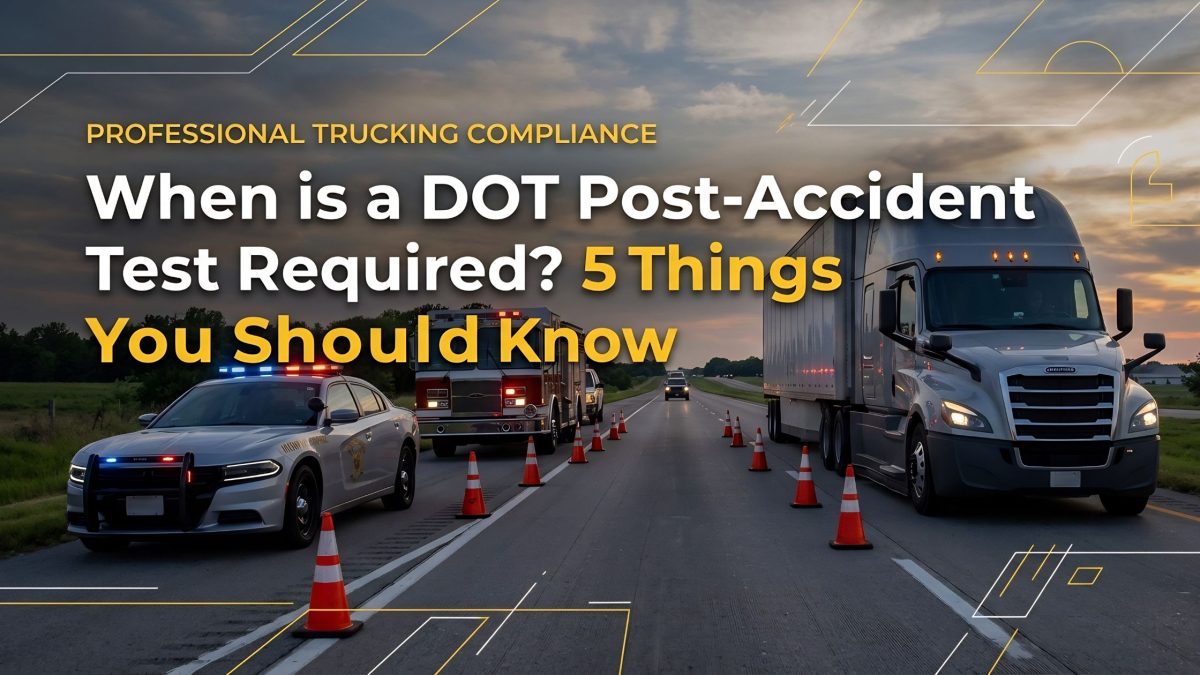
When is a DOT Post-Accident Test Required? 5 Things You Should Know
Getting into an accident is every truck driver’s worst nightmare. Whether it’s a minor fender bender or a more serious collision, the immediate aftermath is a whirlwind of adrenaline, paperwork, and stress. But for commercial motor vehicle (CMV) drivers and fleet managers, there is an extra layer of complexity: the Department of Transportation (DOT) post-accident drug and alcohol testing requirements.
The thing is, not every accident requires a DOT test. However, failing to conduct one when it is required can lead to massive fines, safety rating downgrades, and serious legal headaches. Knowing the rules isn't just about following the law; it's about protecting your career and your company.
At Labworks USA, we see carriers struggle with these definitions every day. That’s why we’ve broken down the 5 essential things you need to know about DOT post-accident testing to keep your operation compliant and your drivers on the road.
1. THE FATALITY RULE: NO QUESTIONS ASKED
If a motor vehicle accident results in a loss of human life, the requirements are crystal clear. Under FMCSA regulation 382.303, any surviving driver who was performing safety-sensitive functions at the time of the accident must be tested for both drugs and alcohol. This rule applies immediately and leaves no room for interpretation.
It doesn’t matter if the driver wasn’t at fault or if the other vehicle caused the crash. If someone died, the DOT requires a post-accident test for the CMV driver. That makes this one of the clearest triggers in the entire regulation.
This is a non-negotiable standard designed to ensure that controlled substances played no role in a fatal event. Quick Tip: Even if law enforcement tells you a test isn't necessary at the scene, if there was a fatality, the DOT mandate overrules their opinion. You should proceed with testing and document your actions right away.
2. BODILY INJURY + A CITATION: THE TWO-PART TRIGGER
Outside of fatalities, the rules get a bit more technical. You might assume that if someone is hurt, a test is required, but that is not necessarily true. In this category, the DOT uses a two-part standard instead of a simple injury-based rule.
For a "bodily injury" accident to trigger a DOT post-accident test, two specific criteria must be met. Those two criteria are immediate off-site medical treatment and a citation issued to the CMV driver. If either part is missing, the DOT post-accident testing requirement is not triggered.
- Immediate Medical Treatment: Someone involved in the accident (the driver, a passenger in another car, or a pedestrian) must receive medical treatment away from the scene of the accident.
- The Citation: The CMV driver must be issued a citation under State or local law for a moving traffic violation arising from the accident.
If a driver is injured but no citation is issued, a DOT post-accident test is not required. Conversely, if a citation is issued but no one is treated away from the scene, you aren't required to test under DOT authority. This is why your team should confirm both facts before making a compliance decision. 
3. TOW-AWAY ACCIDENTS: DAMAGE AND DISPUTES
This is the category where most carriers get tripped up. Many people think that if a truck needs a tow, the driver needs a test. In reality, a tow by itself is not enough to trigger DOT post-accident testing.
Just like the injury rule, the "tow-away" criteria requires a citation to be valid for DOT testing. Testing is required if:
- One or more motor vehicles involved in the accident incurs "disabling damage" and must be transported away from the scene by a tow truck or other vehicle.
- AND the CMV driver receives a citation for a moving violation.
What constitutes "disabling damage"? The FMCSA defines it as damage that precludes the vehicle from being driven in its usual manner in daylight after simple repairs. That definition matters because not every damaged vehicle meets the DOT threshold.
This excludes things like a cracked windshield, broken tail light, or a flat tire that can be changed on-site. If your Peterbilt or Kenworth is still drivable, a tow for insurance reasons alone does not trigger a DOT test unless a citation was also issued. The thing is, many avoidable compliance mistakes happen when carriers confuse a discretionary tow with disabling damage.
4. THE CLOCK IS TICKING: CRITICAL TIME LIMITS
In the world of DOT compliance, timing is everything. Alcohol and drugs leave the system at different rates, and the FMCSA has set strict windows for when these tests must be completed. Once the clock starts, your response process needs to move fast.
If you miss these windows, you must document the reasons why. That documentation can be critical during an audit or investigation. Without it, a delayed or missed test can create serious compliance exposure.
ALCOHOL TESTING LIMITS:
- 2 Hours: You should attempt to get the driver to a collection site within 2 hours.
- 8 Hours: If you cannot get the test done within 8 hours, you must cease all attempts to conduct the alcohol test. You are then required to prepare and maintain a record stating the reasons why the test was not promptly administered.
DRUG TESTING LIMITS:
- 32 Hours: You have a slightly wider window for drug testing. If the test isn't conducted within 32 hours of the accident, you must stop attempting to test and document the delay.
That’s why having a reliable partner like Labworks USA is so important. With our network of over 20,000 collection sites, we can help you find a location quickly, no matter where your driver is in the country. Having that kind of support can make the process more practical when time is tight.

5. DOCUMENTATION IS YOUR ONLY DEFENSE
If a required test isn't performed within the 2, 8, or 32-hour windows, the DOT doesn't just take your word for it that you "tried." You need a paper trail. That documentation is often the only thing standing between your company and a violation.
Failure to perform a required post-accident test is a serious violation. However, the DOT recognizes that sometimes things are out of your control. That is why regulators expect you to show a clear and documented good-faith effort.
Maybe the driver was being treated for their own injuries, or every clinic in a 50-mile radius was closed. In these cases, you must create a "Good Faith Effort" log. This should include:
- Times and dates of calls made to collection sites.
- Names of people you spoke with.
- Reasons given for the inability to test (e.g., "Site was closed," "Driver was in surgery").
Keeping these records in your online account portal ensures that if an auditor ever asks, you have the proof ready to go. Good documentation shows that you made a real compliance effort. It also helps your team respond more confidently if questions come up later.
WHY USE A C/TPA FOR POST-ACCIDENT TESTING?
Managing the aftermath of an accident is overwhelming. Between dealing with insurance, tow companies, and law enforcement, the last thing you want to do is second-guess federal testing regulations. This is exactly when compliance decisions need to be clear and fast.
That’s where a Consortium/Third-Party Administrator (C/TPA) like Labworks USA comes in. We act as your compliance backstop. We help take pressure off your team when time-sensitive testing decisions have to be made.
When you are a member of our DOT Drug and Alcohol Testing Consortium, you have access to:
- 24/7 Emergency Support: Accidents don't happen on a 9-to-5 schedule. Neither do we.
- Electronic Chain of Custody Forms (eCCF): Speed up the process and reduce errors at the collection site.
- MRO Review: Every result is reviewed by a qualified Medical Review Officer to ensure accuracy and fairness.
- Clearinghouse Reporting: We help you manage the mandatory reporting requirements to the FMCSA Clearinghouse.

SUMMARY CHECKLIST FOR POST-ACCIDENT TESTING
To make it easier for your drivers and safety managers, use this quick checklist when an accident occurs. It gives you a simple way to confirm the main DOT triggers and deadlines. You can also use it as a quick reference during internal accident response calls.
- Was there a fatality? -> TEST REQUIRED.
- Was there an injury requiring off-site treatment? -> Check for a citation. If YES citation -> TEST REQUIRED.
- Was a vehicle towed? -> Check for a citation. If YES citation -> TEST REQUIRED.
- Was the alcohol test done within 2 hours? (If not, document at 8 hours).
- Was the drug test done within 32 hours? (If not, document).
IN CONCLUSION
Post-accident testing is one of the most scrutinized areas of DOT compliance. While it might seem like a burden, it is actually a vital safety tool. It plays an important role in both safety enforcement and risk management.
It protects the public by ensuring impaired drivers are off the road. It also protects carriers by providing objective evidence that their driver was sober and fit for duty at the time of an incident. When you understand the triggers, the process becomes much easier to manage.
The key to navigating these high-stress situations is preparation. Don't wait for an accident to happen before you figure out your testing protocols. A clear plan can save time, reduce confusion, and protect your business.
JOIN THE LABWORKS USA CONSORTIUM TODAY
Stay compliant, stay safe, and let us handle the paperwork. Whether you are an owner-operator with one Western Star or a carrier with a fleet of a hundred Mack Trucks, we have a membership level that fits your needs. Our team is here to make compliance simpler and more manageable.
Current Membership Rates:
- Individual/Owner-Operator: $199/year (Includes enrollment, random testing, and Clearinghouse support)
- Small Fleet (2-15 Drivers): Starting at $299/year
- Large Fleet (16+ Drivers): Contact us for custom enterprise pricing
JOIN NOW AND GET COMPLIANT IMMEDIATELY
