
 Aug 19, 2024
Understanding the Deteriorating Safety Record of New Truck and Bus Drivers Today
The increasing concerns surrounding the safety record of newly licensed truck and bus drivers have prompted widespread discourse within the transportation industry.
As the demand for freight and passenger transport continues to rise, so does the urgency to address the alarming trend of accidents involving novice operators.
Despite rigorous training programs and stringent licensing requirements, recent statistics reveal a troubling escalation in incidents attributed to inexperienced drivers.
This phenomenon raises critical questions about the effectiveness of current training methodologies, the psychological pressures faced by new drivers, and the broader implications for road safety. Understanding the factors contributing to this deteriorating safety record is essential for policymakers, educators, and industry stakeholders aiming to develop effective strategies that enhance driver competency and reduce accident rates.
This article delves into the multifaceted challenges encountered by new truck and bus drivers, highlights the gaps in existing training frameworks, and explores potential solutions that could foster safer driving practices.
By examining the intricate dynamics of driver performance, regulatory measures, and industry expectations, we can better comprehend the underlying issues at play and work collectively towards a safer transportation environment for all road users.
Proposal to require proficiency exams for new trucking companies likely delayed again
Recent government statistics indicate a troubling increase in fatalities associated with large-truck accidents involving newly licensed drivers, but the implementation of a proposed safety measure aimed at mitigating these deaths is expected to face further delays.
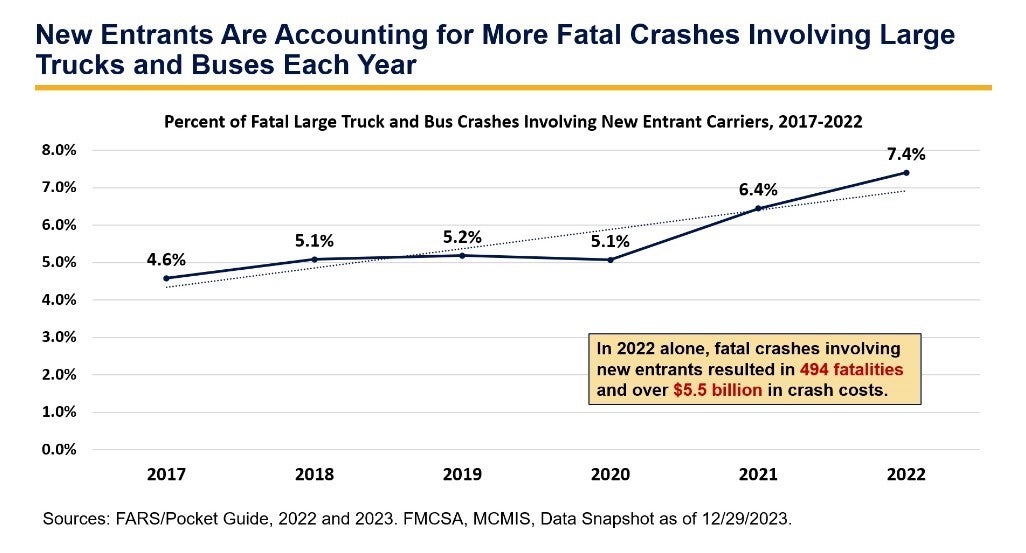
Data from the Federal Motor Carrier Safety Administration (FMCSA) reveals that the proportion of fatal accidents involving new-entrant carriers rose from 4.6% in 2017 to 7.4% in 2022. This increase has led to 494 fatalities and incurred costs exceeding $5.5 billion in 2022 alone.
Kelly Stowe, an engineer with FMCSA, highlighted the ongoing challenges within the agency’s New Entrant Safety Assurance Program, noting that recent graduates from this program continue to be involved in a concerning number of accidents.
During a safety research forum held by FMCSA, Stowe shared an internal analysis comparing the crash rates of carriers that completed the 18-month new-entrant program with those of a control group of established carriers of comparable fleet sizes. The findings indicated that motor carriers operating within two years of graduating from the program experienced double the number of total crashes and nearly twice as many fatal crashes per 100 power units compared to their more seasoned counterparts.
"Even after completing FMCSA’s new-entrant program, which requires passing a safety audit, newer carriers are still involved in accidents at a higher frequency than more established firms," Stowe remarked. "By providing early education and ensuring these carriers understand the operational requirements and expectations, we can potentially reduce the occurrence of these incidents."
Developing a Written Proficiency Examination
Despite these alarming trends, Stowe acknowledged that FMCSA has yet to develop a written proficiency examination, a mandate established by Congress in 2012, which must be completed before a motor carrier can register with the U.S. Department of Transportation. "We are ten years past the original deadline of April 2014," she noted.
Stowe also commented on the anticipated timeline for the proposed rulemaking to establish the proficiency examination, which was expected to commence in July with a publication in the Federal Register, saying, "This timeline will likely be revised. It remains a high-level work plan that is subject to change."
While based on older studies, there is substantial evidence suggesting that implementing such a requirement could significantly lower injuries and fatalities related to new-entrant motor carrier incidents. Stowe referred to research conducted in 2006 and 2012 that contrasted trained carriers with those that did not undergo similar training prior to receiving operational authority. The data showed that drivers from trained carriers not only had substantially lower crash rates but also tended to sustain their businesses for a longer duration.
"We have an opportunity with this program to enhance the safety of new-entrant motor carriers, which could, in turn, lead to improved safety outcomes within the broader population of established carriers over time," concluded Stowe.
In Conclusion
The deteriorating safety record of new truck and bus drivers is a complex issue that warrants urgent attention from industry stakeholders. Factors such as inadequate training, the pressures of tight delivery schedules, and the increasing demand for transportation services contribute significantly to this trend. It is imperative that we prioritize comprehensive training programs, ongoing professional development, and stricter regulatory measures to ensure that new drivers are well-equipped to handle the challenges of the road.
By fostering a culture of safety and accountability within the transport sector, we can work towards reversing this troubling decline and ultimately protect the lives of drivers and the public alike.
If you want to stay updated with a wide range of trends, actionable insights, and innovative solutions in the trucking, freight, and logistics industry, stay connected to us.
Moreover, If you are looking for more information about drug and alcohol testing as a truck driver, visit LabWorks USA.
Our DOT Consortium's friendly team will be more than happy to discuss any concerns you may have and work with you to ensure you are always fully compliant, especially with random DOT drug and alcohol testing. Moreover, if you need help with FMCSA Clearinghouse registration, we can further support you.